
The Google Nest Hub Max is a 10-inch smart display that combines a built-in camera, stereo speakers, Google Assistant (now upgraded to Gemini AI), and smart home control in one device. At $229.99 MSRP, commonly found for 179–199 on sale, it remains one of the most capable smart displays for Google households, even though Google discontinued direct sales in May 2025.
Key takeaways:
-
The Nest Hub Max is a 10-inch HD touchscreen hub priced at $229.99 MSRP, typically 179–199 on sale
-
Built-in 6.5MP camera supports video calling, home monitoring, and Face Match
-
No subscription needed for core features; Nest Aware required for full camera history
-
Works as a Thread border router and Matter controller for smart home devices
-
Google discontinued direct sales in May 2025, available while supplies last through third-party retailers
What Is the Google Nest Hub Max?

The Google Nest Hub Max is Google's largest and most feature-rich smart display. It runs on Google's ecosystem and serves as a kitchen or living room hub for managing smart devices, making video calls, streaming media, and monitoring your home. The 10-inch form factor makes it significantly more practical than the 7-inch Nest Hub for tasks like following recipes or watching content across a room.
It launched in 2019 at $229 and has received firmware-based upgrades since then, most recently gaining Gemini AI capabilities that replaced Google Assistant in 2025.
1. 10-Inch HD Touchscreen With Adaptive Brightness
The Nest Hub Max's display is a 1280 x 800 HD LCD touchscreen with an ambient EQ sensor that automatically adjusts brightness and color temperature to match room lighting. This makes it usable in bright kitchens during the day and dim bedrooms at night without manual adjustment.
The anti-glare coating added in recent hardware revisions reduces reflections near windows, a practical improvement for anyone who's tried using a smart display in a sunlit kitchen.
Honest note: The 1280 x 800 resolution is adequate but not sharp by 2026 standards. If you look closely, pixelation is visible. For distance viewing across a kitchen, it reads well.
2. Built-In 6.5MP Security Camera With Face Match
The Nest Hub Max includes a 6.5-megapixel camera with a 127-degree wide field of view and auto-framing. This is the feature that most meaningfully separates it from the smaller Nest Hub, which has no camera at all.
What the camera does:
-
Hands-free video calling via Google Meet with auto-framing that keeps you centered as you move
-
Doubles as a Nest security camera, detecting motion, sending alerts, and recording clips
-
Face Match recognizes up to six registered users and shows a personalized dashboard when you approach
-
Quick Gestures let you pause music or dismiss timers with a hand wave, without touching the screen
Full security camera functionality, continuous recording, extended clip history, person and pet detection with custom activity zones, requires a Nest Aware subscription ($8/month or $80/year for 60 days of event history).
For households that want a home monitoring camera built into a kitchen display rather than a separate device, this dual-purpose design has real practical value. For comparison with standalone options, see our guide to how do motion alerts work on security cameras.
3. Gemini AI Voice Assistant

The Nest Hub Max shipped with Google Assistant and received a firmware upgrade to Gemini AI in 2025. Gemini brings more natural conversational responses, generative routines, and improved follow-up question handling compared to standard Google Assistant.
In practice, the far-field microphone array picks up voice commands reliably from across a kitchen. The two microphones are fewer than Amazon's seven-mic Echo arrays, but Google's speech processing closes most of the gap for wall-mounted placements.
What Gemini adds over standard Assistant:
-
More natural multi-turn conversations
-
Generative routine suggestions based on your usage patterns
-
Better handling of open-ended questions with nuanced answers
-
Camera Intelligence beta: searchable event descriptions from Nest Cam clips
4. Stereo Speaker System
The Nest Hub Max includes a proper three-driver speaker system: two 18mm tweeters and one 75mm woofer producing 30W total output. For a smart display, this is genuinely good, noticeably better than the small speakers in Echo Show devices at comparable price points.
In a kitchen environment, the Nest Hub Max fills the room with music at comfortable volumes without distortion. It handles podcast speech clearly and manages bass-heavy music with more presence than its size suggests.
This is the right choice if you want a single kitchen device that handles music well rather than pairing a separate Bluetooth speaker to a smart display.
5. Smart Home Control and Matter Support

The Nest Hub Max functions as a hub within Google Home, supporting Matter and Thread for smart device management. The built-in Thread border router enables local communication with Thread-based devices, keeping automations responsive even when internet connectivity is spotty.
Supported protocols:
-
Matter (over Wi-Fi and Thread)
-
Thread (802.15.4 at 2.4 GHz, built-in border router)
-
Wi-Fi (802.11b/g/n/ac, dual-band 2.4GHz/5GHz)
-
Bluetooth 5.0
-
Chromecast built-in
What it doesn't support: Zigbee and Z-Wave. This is a meaningful limitation if you own smart locks, sensors, or other devices using those protocols. The Amazon Echo Hub includes a built-in Zigbee radio at a lower price point, making it the stronger choice for mixed-protocol homes.
For a full breakdown of choosing the right hub for your device mix, see smart home hub buying guide: 7 questions to ask before you choose one.
6. Digital Photo Frame With Google Photos
When idle, the Nest Hub Max displays a rotating gallery of your Google Photos library. This is one of the most consistently praised features by owners, the large display makes it a genuinely useful digital photo frame rather than an afterthought.
The ambient mode uses the built-in ambient light sensor to adjust the display so photos look natural at any light level. You can curate which albums show, set display speed, and filter by date ranges or people.
This use case is strongest when the Nest Hub Max is placed in a kitchen or living area where it's visible throughout the day. In a dedicated bedroom or office, the idle display is a minor feature. In a main living space, it earns its footprint on the counter.
7. Chromecast Built-In for Streaming

The Nest Hub Max can stream content directly from YouTube, YouTube TV, Disney+, Hulu, Max, and Sling. You can also cast from your phone to the Nest Hub Max using Chromecast, which works with any Cast-compatible app.
Important limitation: The Nest Hub Max does not run Android and cannot stream Netflix directly by voice command. You can link your Netflix account in the Google Home app, but voice-commanded Netflix playback is unreliable. Casting from the Netflix app on your phone to the Nest Hub Max works, but it requires the extra step.
For a kitchen display where YouTube and YouTube TV cover most of your streaming needs, this isn't a daily frustration. If Netflix is your primary streaming service, this gap is worth knowing before you buy.
8. Privacy Controls
The Nest Hub Max includes a hardware microphone and camera switch, a physical button that disconnects both the mic and camera at the hardware level, not just a software toggle. When the switch is off, the camera cannot transmit footage regardless of any software state.
Additional privacy features:
-
On-device voice recognition for Hey Google activation (voice data can be set to not be sent to Google servers)
-
Camera LED indicator shows when the camera is actively sensing
-
Pause cloud clip upload option in the Device Access Sandbox
The on-device Soli radar sensor (present in the smaller Nest Hub for sleep tracking) is not included in the Nest Hub Max. This means no sleep tracking, but also no continuous presence sensing beyond the camera.
For a deeper look at how cloud versus on-device AI processing affects your home's privacy posture, the OVAL AI Home Hub: the future of privacy-first security article covers the architectural difference in detail.
9. No Subscription Required for Core Features
Unlike most professional monitoring systems, the Nest Hub Max does not require a monthly subscription for its primary functions. Smart home control, Google Assistant/Gemini, streaming, video calling, Google Photos, and basic motion alerts are all included with the hardware purchase.
Nest Aware ($8/month) adds: 60 days of video event history, extended clip access, person and pet detection, activity zones, and the Active Guard monitoring feature. Without it, you get 3 hours of event history.
For households that want smart home control and video calling without a recurring fee, this matters. For those who want the security camera features to work fully, budget 80–120/year additionally. Over five years, that adds 400–600 to the total cost.
For more on how subscription costs affect smart home systems over time, see how on-device AI saves you $200+ a year.
Who Should Buy the Google Nest Hub Max
Buy it if:
-
You're already in the Google ecosystem (Nest cameras, Google Home, Android)
-
You want a capable kitchen hub that handles video calls, music, and home control in one device
-
You want a large digital photo frame that's always on display
-
You don't need Zigbee or Z-Wave device support
Skip it if:
-
You use Alexa primarily, the Echo Show line integrates far more naturally
-
Your home uses Zigbee or Z-Wave smart locks or sensors
-
You want Netflix streaming by voice command (it doesn't work reliably)
-
You want actively intelligent security alerts, the Nest Hub Max reacts to motion but doesn't classify events or provide contextual AI security analysis
Renters: The Nest Hub Max works well in any space without installation. It's genuinely portable, unplug it, move it to a new home, plug it back in.
Families with young children: The Face Match personalization, Google Photos display, and Google Meet calling make it practical for family use. It does not include child safety-specific alerts. For households prioritizing that layer, see home security devices for families.
Google Nest Hub Max vs Key Alternatives
|
Feature |
Nest Hub Max |
Echo Show 15 |
Echo Show 8 |
|
Screen |
10" HD |
15.6" FHD |
8" HD |
|
Price |
$229.99 |
$249.99 |
$149.99 |
|
Camera |
6.5MP |
5MP |
13MP |
|
Protocols |
Matter, Thread, Wi-Fi |
Matter, Zigbee, Wi-Fi |
Matter, Wi-Fi |
|
Best for |
Google households |
Alexa households, large display |
Budget, bedroom |
|
Netflix |
Unreliable by voice |
Yes |
Yes |
|
Subscription needed |
Optional (Nest Aware) |
Optional (Ring/Alexa+) |
Optional |
The Echo Show 15 has a dramatically larger display and includes Zigbee, which is a meaningful hardware advantage for mixed-protocol smart homes. The Nest Hub Max wins on camera quality for video calling, sound quality, and Google ecosystem depth.
For a direct ecosystem-level comparison, our article on how to control your entire home with one app covers the trade-offs between Alexa, Google Home, and hub-based platforms.
Is the Google Nest Hub Max Still Worth Buying in 2026?
The Nest Hub Max is six-year-old hardware in maintenance mode. Google discontinued direct sales in May 2025. That context matters: you're buying a device that will continue receiving software updates but is unlikely to gain new hardware-dependent features.
At 179–199 on sale from third-party retailers, it remains a well-priced kitchen hub for Google households. At full MSRP of $229, newer alternatives, particularly the Echo Show 15 for Alexa users, offer more compelling value.
The Gemini AI upgrade extends the device's useful life meaningfully. If Google continues pushing Gemini features to it via firmware, the software story improves even as the hardware ages.
Bottom line: Buy it on sale if you're a Google household wanting a capable kitchen display. Wait or consider alternatives if you need broad protocol support, Netflix streaming by voice, or AI-powered security that goes beyond basic motion detection.
If the security intelligence gap is the specific thing holding you back, the difference between a camera that records motion and a system that tells you what's actually happening, see our guide on what is an AI Home Hub and do you actually need one for what that next tier looks like.
Looking for More Than a Smart Display Can Offer? Try OVAL AI Home Hub
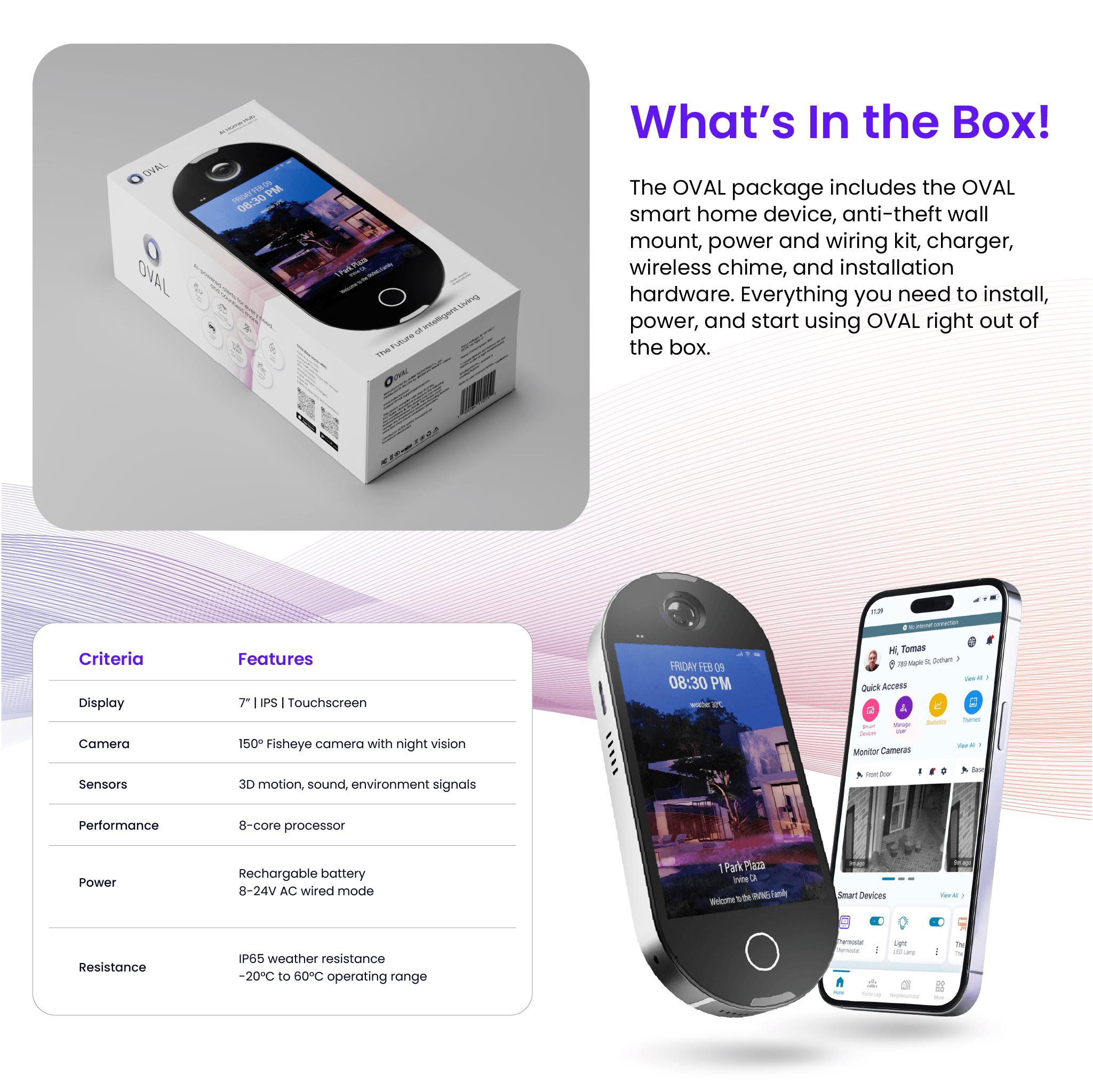
The Nest Hub Max is a strong kitchen hub. What it isn't is an active security intelligence system, it detects motion, but doesn't classify events, identify behavioral patterns, or proactively alert you to specific threats like a weapon at the door, a toddler approaching a hazard, or an intruder distinguishable from a known visitor.
OVAL by IRVINEi, the world's first AI Home Hub, runs on-device Edge AI with 11 contextual alert categories, connects 3,000+ smart devices, and requires no cloud subscription for core security features. IP65-rated, Gorilla Glass, built for your front door.
Frequently Asked Questions
What are the best features of the Google Nest Hub Max?
The nine standout features are its 10-inch HD adaptive touchscreen, built-in 6.5MP security camera with Face Match, Gemini AI voice assistant, 30W stereo speaker system, Matter and Thread smart home hub support, Google Photos digital frame, Chromecast streaming, hardware privacy switch, and no required subscription for core features.
Does the Google Nest Hub Max work as a security camera?
Yes. The built-in 6.5MP camera functions as a Nest security camera with motion detection and live viewing. Full features, 60-day clip history, person and pet detection, activity zones, require a Nest Aware subscription ($8/month). Without it, event history is limited to 3 hours.
Is the Google Nest Hub Max still available in 2026?
Google discontinued direct sales in May 2025. The Nest Hub Max is available from third-party retailers while supplies last, typically at 179–199 on sale versus the $229.99 MSRP.
Does the Google Nest Hub Max support Matter?
Yes. The Nest Hub Max includes a built-in Thread border router and supports Matter over Wi-Fi and Thread. It does not support Zigbee or Z-Wave, which limits compatibility with older smart home devices using those protocols.
What is the difference between the Google Nest Hub Max and the regular Nest Hub?
The Nest Hub Max has a 10-inch display (versus 7 inches), a built-in 6.5MP camera (the Nest Hub has no camera), a more powerful 30W stereo speaker system (versus 10W), and a Thread border router. The Nest Hub is $99.99 and better suited for bedrooms; the Nest Hub Max is $229.99 and designed for kitchens and living areas.
Can the Google Nest Hub Max stream Netflix?
Not reliably by voice command. The Nest Hub Max does not run Android, and voice-prompted Netflix playback is inconsistent. Casting Netflix from your phone via Chromecast works. If Netflix is your primary service, this limitation is worth considering before buying.
Does the Google Nest Hub Max need a subscription?
No subscription is required for smart home control, Google Assistant/Gemini, streaming, video calling, Google Photos, or basic motion alerts. The optional Nest Aware subscription ($8/month or $80/year) adds extended video history, AI event detection, and Active Guard monitoring.
What is Face Match on the Google Nest Hub Max?
Face Match is a feature that recognizes registered household members using the built-in camera and shows a personalized ambient dashboard when that person approaches. It supports up to six faces. Recognition data is stored on-device by default. It is enabled through the Google Home app and can be turned off at any time.
