
Leaving your home unattended can feel like a gamble, even for the most tech-confident homeowner. As smart devices multiply, the difference between having a ‘connected’ house and enjoying real automation in smart home environments shapes your family’s safety and peace of mind. Today’s intelligent systems offer more than convenience—they combine security, privacy, and companionship, creating homes that adapt to your lifestyle while keeping your personal data where it belongs: under your own roof.
Table of Contents
- Defining Automation In Smart Home Environments
- Types Of Smart Home Automation Systems
- How Edge Ai Empowers Privacy And Security
- Real-World Uses: Security, Companionship, And Control
- Risks, Limitations, And Privacy Challenges
- Comparing Cloud-Based And Edge-Based Automation
Key Takeaways
| Point | Details |
|---|---|
| Automation Enhances Living Experience | Smart home automation allows devices to anticipate user needs, freeing mental space by managing routine tasks seamlessly. |
| Multiple Automation Systems Exist | Various smart home systems prioritize functions like energy management, security, and convenience; choose one that fits your lifestyle. |
| Edge AI Improves Privacy and Responsiveness | Edge AI processes data locally, enhancing security and response times while keeping personal information within the home. |
| Understand Risks and Trade-offs | Be aware of potential security vulnerabilities and privacy challenges with smart home devices to make informed decisions. |
Defining Automation in Smart Home Environments
Automation in smart homes refers to the ability of interconnected devices and systems to perform tasks automatically based on preset conditions, user commands, or environmental triggers, all without requiring manual intervention each time. Think of it as teaching your home to anticipate your needs. When you wake up, your lights gradually brighten. When you leave, your door locks itself. When the temperature drops, your thermostat adjusts. These aren’t magical occurrences. They’re the result of intelligent systems communicating with each other to create a seamless living experience.
The core distinction between a standard smart home device and true home automation lies in integration and intelligence. A single smart speaker that plays music is convenient, but it’s not automation. A system where that speaker understands your routine, communicates with your lighting system, adjusts your thermostat, and monitors your security simultaneously, that’s automation. The difference becomes clear when you consider how smart home automation transforms traditional homes into responsive ecosystems. Recent research highlights how contemporary smart home frameworks have evolved to encompass not just technical features but also the social dimensions of how people actually live, creating balanced environments that enhance daily quality of life rather than simply adding connected gadgets.
What makes automation in smart home environments genuinely useful is the removal of decision fatigue from routine tasks. Your home learns when you typically arrive home, when you prefer certain temperatures, and how you like your spaces lit at different times of day. The system then executes these preferences automatically, freeing your mental energy for what actually matters. This is fundamentally different from traditional home management, where you manually controlled each element. The complexity happens behind the scenes through sensors, artificial intelligence, and interconnected protocols that allow your devices to communicate seamlessly. Your involvement shifts from constant control to occasional adjustment, giving you both convenience and genuine peace of mind.
Pro tip: Start defining automation by identifying your most repetitive daily tasks, then begin automating those first—this approach prevents overwhelming yourself with complex setups while delivering immediate, noticeable benefits.
Types of Smart Home Automation Systems
Smart home automation systems come in several distinct varieties, each designed to handle different aspects of your home management. The primary distinction between them boils down to what they control and how they communicate. Some systems focus exclusively on security monitoring and alerts. Others prioritize energy management and climate control. The most comprehensive systems integrate multiple functions into a unified platform that handles security, convenience, lighting, temperature, and appliance management all at once. Understanding these different types helps you choose what actually fits your lifestyle rather than buying solutions for problems you don’t have.
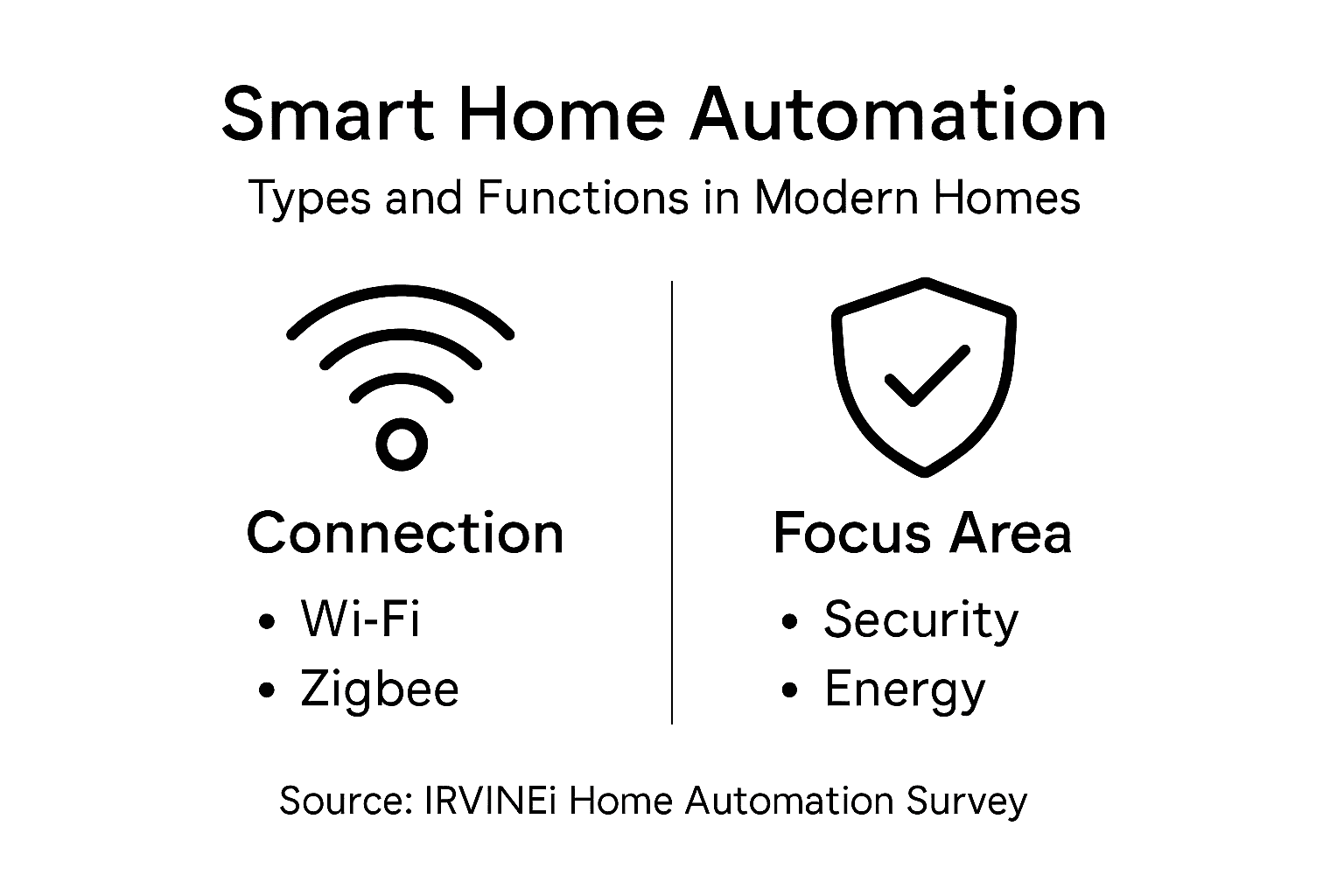
The technical backbone of any automation system determines its reliability and capabilities. Systems typically rely on IoT networking technologies that can be wired, wireless, or hybrid approaches, each with distinct advantages depending on your home’s layout and your specific needs. Wired systems offer superior reliability and data integrity but require installation during construction or significant renovation. Wireless systems provide flexibility and easier installation but depend on network strength and can face interference issues. Many modern homes benefit from hybrid approaches that use wireless for convenience where possible and wired connections for critical systems like security. The choice fundamentally affects how responsive your home feels and how reliably it performs when you need it most.
Beyond connectivity, automation systems break down by their functional focus. Energy management systems track power consumption and optimize heating, cooling, and appliance operation to reduce utility costs. Security automation systems monitor entry points, detect unusual activity, and can trigger alerts or lock-downs automatically. Convenience systems handle lighting, blinds, entertainment, and appliance scheduling based on your routine. The most sophisticated implementations combine IoT integration with artificial intelligence, allowing your home to learn your patterns and make intelligent decisions rather than simply following rigid schedules. Your home becomes genuinely adaptive rather than just automated. This matters because real-world living involves flexibility, unexpected changes, and evolving preferences that rigid programming cannot accommodate.
Here’s a breakdown of key smart home automation system types and their primary benefits:
| System Type | Primary Focus | Key Advantage |
|---|---|---|
| Energy Management | Power use optimization | Lowers utility costs |
| Security Automation | Threat detection | Provides instant alerts |
| Convenience Systems | Routine task scheduling | Increases comfort and ease |
| Integrated Platforms | Multi-function control | Full-home seamless experience |
Pro tip: Start by categorizing which automation problems frustrate you most in your daily routine, then select a system type that directly addresses those specific pain points rather than attempting comprehensive automation all at once.
How Edge AI Empowers Privacy and Security
Traditional smart home systems send your data to the cloud. Your security camera footage, your daily routines, your temperature preferences, your lock status. All of it travels to remote servers operated by companies you may not fully trust. Edge AI changes this fundamental dynamic by processing sensitive information directly on devices in your home rather than transmitting it elsewhere. The difference is profound. When artificial intelligence runs locally on your devices, your personal data never leaves your walls. No cloud servers store your patterns. No third parties analyze your movements. Your home becomes genuinely private because the intelligence that makes it smart operates entirely under your control.

Local data processing with edge AI eliminates the privacy risks inherent in cloud-dependent architectures while simultaneously improving how quickly your home responds to your needs. When your security system detects motion at the door, it doesn’t need to send that information to a distant server and wait for a response. Your local AI evaluates the situation instantly and acts immediately. This responsiveness matters during emergencies when milliseconds count. A person breaking into your home cannot wait for cloud processing delays. The system must understand the threat and respond before danger escalates. Beyond security, this speed enhancement transforms how smoothly your automation feels. Lights respond instantly to your presence. Your thermostat adjusts the moment conditions change. The experience feels intelligent rather than delayed.
What makes edge AI particularly powerful for privacy is that it fundamentally shifts who controls your data. You own your devices. You own the AI running on them. When responsible AI governance operates at the edge, you maintain complete transparency over what decisions your home makes and why. You can audit the logic. You can modify preferences. You can understand exactly how your devices interpret your behavior. This contrasts sharply with cloud-based systems where proprietary algorithms operate invisibly on remote servers. You have no way to verify what they do with your information or how they use patterns extracted from your daily life. Edge AI restoration gives homeowners genuine agency over their privacy and security simultaneously. Your home protects you without demanding that you sacrifice your autonomy to distant corporations.
Pro tip: When evaluating smart home systems, specifically ask whether the AI and decision making happens locally on edge devices or if data gets transmitted to cloud servers, then prioritize systems that process information entirely within your home.
Real-World Uses: Security, Companionship, and Control
Smart home automation delivers tangible benefits in three critical areas of modern living. Security goes beyond traditional locks and alarm systems to provide real-time threat detection and response capabilities that operate continuously, whether you’re home or traveling for business. Companionship addresses the growing isolation many people experience, offering connection and assistance when family members cannot be physically present. Control empowers residents to shape their environment according to personal preferences rather than accepting whatever conditions their surroundings impose. These three pillars work together to transform how people actually live in their homes, addressing practical needs that matter to North American homeowners seeking both safety and autonomy.
Security automation protects your home through intelligent monitoring and rapid response systems. Smart home security implementations include surveillance that identifies unusual activity, intrusion detection that alerts you instantly, and emergency response capabilities that can contact authorities or trigger protective measures automatically. A motion detector at your back door doesn’t simply record video. Advanced systems analyze that motion to distinguish between a passing animal and an actual intruder, eliminating false alarms that plague traditional systems. When genuine threats emerge, the system responds immediately without waiting for you to discover the problem or take action. You receive alerts on your phone within seconds, with clear information about what triggered the alarm and where it occurred. This shifts your role from constant vigilance to informed awareness.
Companionship automation provides meaningful interaction and assistance, particularly valuable for people living alone or managing mobility limitations. Voice-controlled interfaces allow you to check in with family remotely, receive reminders for medications or appointments, and access emergency assistance without physical buttons or phones. Automated lighting and climate control create comfortable environments automatically, reducing the physical effort required to manage your space. For seniors or people with disabilities, this independence proves invaluable. Rather than depending on others to adjust your environment or remember important tasks, your home actively supports your daily routines. The system becomes a reliable presence that works tirelessly without judgment or fatigue.
Control automation addresses the fundamental human desire to shape your environment. Voice command technologies and remote monitoring systems let you manage lighting, temperature, appliances, and security from anywhere. You’re in the office and realize you left lights on. Turn them off from your phone. You’re driving home on a cold day. Start heating before you arrive. You’re traveling across the country and want to verify your door locked. Check instantly. This level of control eliminates the helpless feeling of being disconnected from your own space. Your home responds to your intentions rather than forcing you to accept whatever conditions exist.
Pro tip: Prioritize automation in areas that create daily friction or safety concerns first, then expand gradually once you understand your preferences, rather than attempting complete automation across all home systems simultaneously.
Risks, Limitations, and Privacy Challenges
Smart home automation systems offer genuine benefits, but they introduce real risks that deserve honest discussion. No system is perfectly secure. Every connected device represents a potential entry point for unauthorized access. Every data transmission carries the possibility of interception. Every convenience feature carries privacy implications. The question isn’t whether risks exist. They do. The question is whether you understand those risks clearly enough to make informed decisions about what automation you actually want in your home.
Security vulnerabilities in interconnected smart home systems stem from the fundamental challenge of securing dozens of devices communicating with each other and external services. A weakness in your smart thermostat could theoretically provide access to your entire network. Outdated security patches on forgotten devices create openings for attackers. Poor encryption on data transmission means information traveling from your home could be intercepted and read by unauthorized parties. Weak authentication allows someone to control your devices if they discover or guess your passwords. These aren’t theoretical problems. Security researchers regularly discover vulnerabilities in commercial smart home devices that could allow hackers to unlock doors, disable alarms, or access security camera feeds. The manufacturers eventually release patches, but lag times between discovery and availability mean you’re exposed during that window.
Beyond security breaches, privacy challenges emerge from how smart home systems handle sensitive resident data collected through constant monitoring. Your daily patterns reveal intimate details about your life. When you wake. When you sleep. When you’re home. When you’re away. Who visits. What activities you pursue. This behavioral data possesses tremendous value to marketers, insurers, and other entities who might want to understand or influence your decisions. Cloud-based systems transmit this information to company servers where privacy policies determine what happens next. Even when companies claim they don’t sell data directly, aggregated behavioral patterns get analyzed for business purposes you never explicitly consented to. The interoperability challenge compounds this problem. Smart home devices often don’t work well together without cloud integration, forcing you to choose between convenience and privacy.
Limitations in emergency responsiveness also matter. Automated systems excel at handling routine situations but struggle with unexpected scenarios. Your system might not distinguish between an emergency requiring immediate action and a false alarm. Connectivity failures mean your automation stops working during exactly the moments when you might need it most. Loss of power eliminates your smart locks, security systems, and environmental controls simultaneously. These aren’t flaws in specific products. They reflect fundamental constraints in how automation currently operates.
Pro tip: Before purchasing smart home devices, research specific security track records and privacy policies, verify encryption standards, ensure regular security update availability, and prioritize systems designed for local processing rather than cloud dependency.
Comparing Cloud-Based and Edge-Based Automation
Two fundamentally different approaches exist for delivering smart home automation. Cloud-based systems process data on remote servers operated by companies elsewhere. Edge-based systems process data locally on devices within your home. This distinction determines where your information goes, how quickly your home responds, whether your system works during internet outages, and who ultimately controls your automation. Understanding the trade-offs between these approaches allows you to make choices aligned with your actual priorities rather than accepting whatever approach manufacturers default to.
Cloud-based automation offers genuine advantages in computational power and scalability. Remote servers can run complex algorithms that analyze your behavioral patterns across millions of homes, identifying insights that genuinely improve your experience. System updates deploy instantly across all users simultaneously. Integration between different manufacturers’ products becomes easier when everything communicates through cloud platforms. The cost structure favors cloud providers because they distribute server expenses across numerous users. These benefits explain why most consumer-level smart home products default to cloud architecture. But these advantages come with significant tradeoffs. Edge-based automation systems keep your data local rather than transmitting it to external servers, eliminating the exposure that cloud architectures inherently create. Your behavioral patterns never leave your home. No cloud provider analyzes when you wake, when you sleep, or what activities you pursue. Your system functions completely during internet outages, continuing to protect your home and maintain your comfort even when connectivity fails.
Edge computing designs enable local data processing that reduces latency significantly compared to cloud systems. When your motion detector triggers, your edge-based system responds within milliseconds because the decision happens locally rather than requiring a round-trip to distant servers. During emergencies, this speed difference matters enormously. Security threats require immediate response. Cloud systems introduce delay while data travels to servers and responses return. Edge systems eliminate that latency entirely. The responsiveness feels dramatically better because your home reacts to your needs instantaneously rather than after slight delays. The reliability improves too. Internet outages disable cloud-based systems entirely, leaving you unable to control your locks, thermostats, or security. Edge systems continue operating normally because they depend only on your local network.
The optimal approach often involves hybrid designs that balance the strengths of both methods. Edge systems handle critical real-time functions like security responses and climate control where latency and reliability matter most. Cloud systems handle non-critical analytical functions where computational power adds genuine value. This hybrid strategy delivers responsiveness and privacy where it counts while retaining scalability and sophisticated analysis for less time-sensitive functions. Your home becomes both fast and intelligent rather than forcing you to choose between these qualities.
This table compares cloud-based and edge-based automation methods for smart homes:
| Feature | Cloud-Based Automation | Edge-Based Automation |
|---|---|---|
| Data Privacy | Data sent off-site | Data stays in your home |
| Response Speed | Potential cloud delays | Instant, local responses |
| Internet Outages | System often disabled | Usually functions normally |
| User Control | Provider manages logic | Homeowner can audit/adjust |
Pro tip: Prioritize edge-based processing for security and climate control functions, then evaluate whether specific conveniences genuinely justify cloud transmission, rather than accepting cloud-first architectures as inevitable.
Experience True Privacy and Control with Edge AI Smart Home Solutions
The article highlights the challenges of maintaining privacy and achieving seamless control in smart home automation. If you are concerned about cloud exposure of your personal data, desire instant local responsiveness, and want a home that adapts intelligently without compromising security, IRVINEi offers a breakthrough. Our AI Hub, OVAL, runs entirely on Edge AI technology to deliver privacy, security, and comfort in one elegant device. By keeping all AI decision making inside your home, OVAL eliminates cloud-based delays and risks while providing powerful automation and companionship features.

Discover how OVAL transforms your living space into a truly intelligent environment by visiting our Home page – IRVINEi. Explore the future of smart home security and automation without sacrificing your privacy at https://hellooval.com. Take control today and elevate your lifestyle with the next generation of edge-enabled smart home solutions.
Frequently Asked Questions
What is automation in smart homes?
Automation in smart homes refers to the interconnected devices and systems in your home that perform tasks automatically based on user commands or environmental triggers, offering convenience and freeing you from manual control.
How does edge AI contribute to privacy in smart homes?
Edge AI processes data locally on devices, keeping your personal information within your home and eliminating reliance on cloud servers, which enhances data privacy and security.
What are the main benefits of smart home automation?
Smart home automation improves security through real-time monitoring, enhances companionship by providing interaction and assistance, and offers control over environmental settings based on personal preferences.
How do cloud-based systems compare to edge-based systems in smart homes?
Cloud-based systems process data off-site, potentially exposing user data and causing delays in response. In contrast, edge-based systems maintain data locally, allowing for instant responses and enhanced privacy, especially in critical functions.
