
Finding a security system that truly understands your home’s patterns can feel elusive when you live in a busy city. With so many AI-powered devices touting smart protection, the real challenge is securing your property intelligently while keeping your privacy and control intact. This article breaks down the core principles behind AI home security, revealing how local threat analysis and robust system design deliver actionable protection and put you at the center of every decision.
Table of Contents
- AI For Home Security: Core Principles
- Edge AI Vs. Cloud AI For Privacy And Control
- Key Features Of AI-Powered Security Devices
- Real-World Applications And User Scenarios
- Risks, Costs, And Common Missteps
- Alternatives And The Future Of Home Security
Key Takeaways
| Point | Details |
|---|---|
| AI enhances home security | AI-powered systems provide real-time threat detection and classification, shifting from reactive to predictive security. |
| Privacy and control are paramount | Choose edge AI systems that process data locally, keeping your information secure and under your control. |
| Real-time monitoring reduces false alarms | Effective AI security systems adapt to your environment, learning normal patterns to minimize unnecessary alerts. |
| Evaluate your options carefully | Consider the implications of data ownership and potential vendor risks when selecting a security solution. |
AI for Home Security: Core Principles
When you’re evaluating AI for home security, you’re really looking at how artificial intelligence can make decisions in real-time about threats happening at your front door or in your backyard. Unlike traditional security systems that simply record footage or trigger alarms, AI-powered systems analyze what’s happening as it happens. They understand the difference between your dog crossing the yard and an actual intruder. They recognize suspicious behavior patterns instead of just motion. That’s a fundamental shift from reactive security to predictive security, and it changes how you can protect your property.
The core principles of AI home security start with threat detection and classification, which means the system doesn’t just spot movement but understands what kind of movement matters. If your neighbor’s car passes by, the system knows that’s normal. If someone lingers at your front entrance or tries multiple doors, the system flags this as suspicious. This accuracy matters because it eliminates thousands of false alarms that plague older motion-sensor systems. You get notifications about actual threats, not every shadow or animal that passes through your yard. This intelligence happens locally on your device without sending your video feeds to distant servers, keeping your privacy intact while maintaining security.
The second principle centers on secure system architecture and lifecycle protection. This means your AI system must follow standards that protect it from the ground up, through its entire operation, and eventually to its retirement. The baseline cybersecurity requirements for AI address specific vulnerabilities like data poisoning and model manipulation, ensuring that someone can’t trick your system into ignoring real threats. Your home security AI needs protection during design, development, deployment, and ongoing maintenance. Without this lifecycle approach, an intelligent system could become a liability rather than an asset. Continuous learning and adaptation forms the third pillar. Your home changes seasonally and over time. Trees grow and create new shadows. You might install new outdoor lighting. Your daily routines shift. An AI system that cannot adapt to these changes becomes outdated and unreliable. The best systems learn from your feedback and environment, improving their accuracy month after month without requiring your constant recalibration.
Implementing these principles requires deploying AI systems securely with attention to confidentiality, integrity, and availability. Confidentiality means your video feeds and behavioral data stay private. Integrity means nobody can modify the system’s decisions or feed it false information. Availability means the system works reliably when you need it, without unexpected failures. These three factors work together. A system that exposes your footage loses confidentiality. A system that someone can manipulate loses integrity. A system that frequently crashes loses availability. Your AI home security needs all three to actually protect you.
When you look at products claiming to use AI for home security, check whether they explain their principles. Do they discuss how they protect your privacy? Do they explain how the system prevents manipulation? Do they address what happens when their company updates the software? These questions reveal whether the manufacturer truly understands these core principles or is simply using “AI” as a marketing term. Real AI home security built on solid principles gives you intelligence, privacy, and control working together, not competing against each other.
Pro tip: Start by choosing an AI security system that processes video on your own device rather than relying on cloud servers, which not only protects your privacy but also ensures your system works even if your internet connection drops.
Edge AI vs. Cloud AI for Privacy and Control
The choice between edge AI and cloud AI for your home security comes down to where your data gets processed and who can access it. Edge AI runs the intelligence directly on your home device. Cloud AI sends your video and sensor data to distant servers for analysis. This difference sounds technical, but it fundamentally changes your privacy, your control, and how your system responds to threats. When you understand this distinction, you can make an informed choice about what actually protects your home and your family.
Edge AI processes everything locally. Your security camera analyzes video on the device itself. Your motion sensors make decisions without phoning home to a company server. This approach delivers real-time processing with minimal latency, meaning your system detects threats and responds in milliseconds instead of seconds. Your front door camera identifies a suspicious person and alerts you instantly, not after a round trip to some data center hundreds of miles away. The critical advantage for home security is that sensitive information stays on your device. Your video feeds, your daily patterns, your family’s movements, and your home layout never leave your property. Nobody’s servers store footage of your children playing in the backyard or your nighttime routines. This isn’t just privacy theater. It’s actual privacy by design. When a breach happens at a cloud company, your data stays safe because it was never there to steal.
Cloud AI takes the opposite approach. Your devices send raw data to powerful servers that perform the analysis and send back results. Cloud platforms offer genuine advantages. They access enormous computational power for processing complex scenarios. They use data from millions of homes to continuously improve their AI models. They can handle multiple simultaneous users without straining your home network. They scale easily as your security needs grow. But this convenience comes with trade-offs. Your data travels across the internet multiple times daily. It sits on company servers. It gets backed up, cached, and processed by systems outside your control. Companies can change their privacy policies. Governments can demand access. Hackers target these centralized databases because they contain millions of homes’ worth of data. Cloud AI also depends on internet connectivity. If your connection drops, your security degrades. If the company experiences an outage, you’re left unprotected.
The distinction matters because edge AI provides improved privacy and cybersecurity through local data processing, reducing exposure from cloud transmission. For home security specifically, this means your threat detection happens without your data becoming a commodity. Your system learns your home’s patterns without uploading behavioral profiles to distant servers. You maintain control over how your security system operates. You’re not subject to changing subscription models or forced algorithm updates that degrade performance. You don’t have to worry about data retention policies or breaches affecting your family’s safety records. Edge AI also works when your internet fails. A power outage or router malfunction doesn’t disable your security.
The future of AI is on the edge because this architecture aligns with how people actually want security to work. You want something that protects your family right now, not something that trades your privacy for convenience. You want control over your security decisions, not algorithms optimized for company profit. You want your data staying in your home, not distributed across corporate infrastructure. This doesn’t mean cloud AI has no place. Some homeowners prefer the scalability and advanced features. The choice should be yours, not determined by what companies find easiest to monetize.
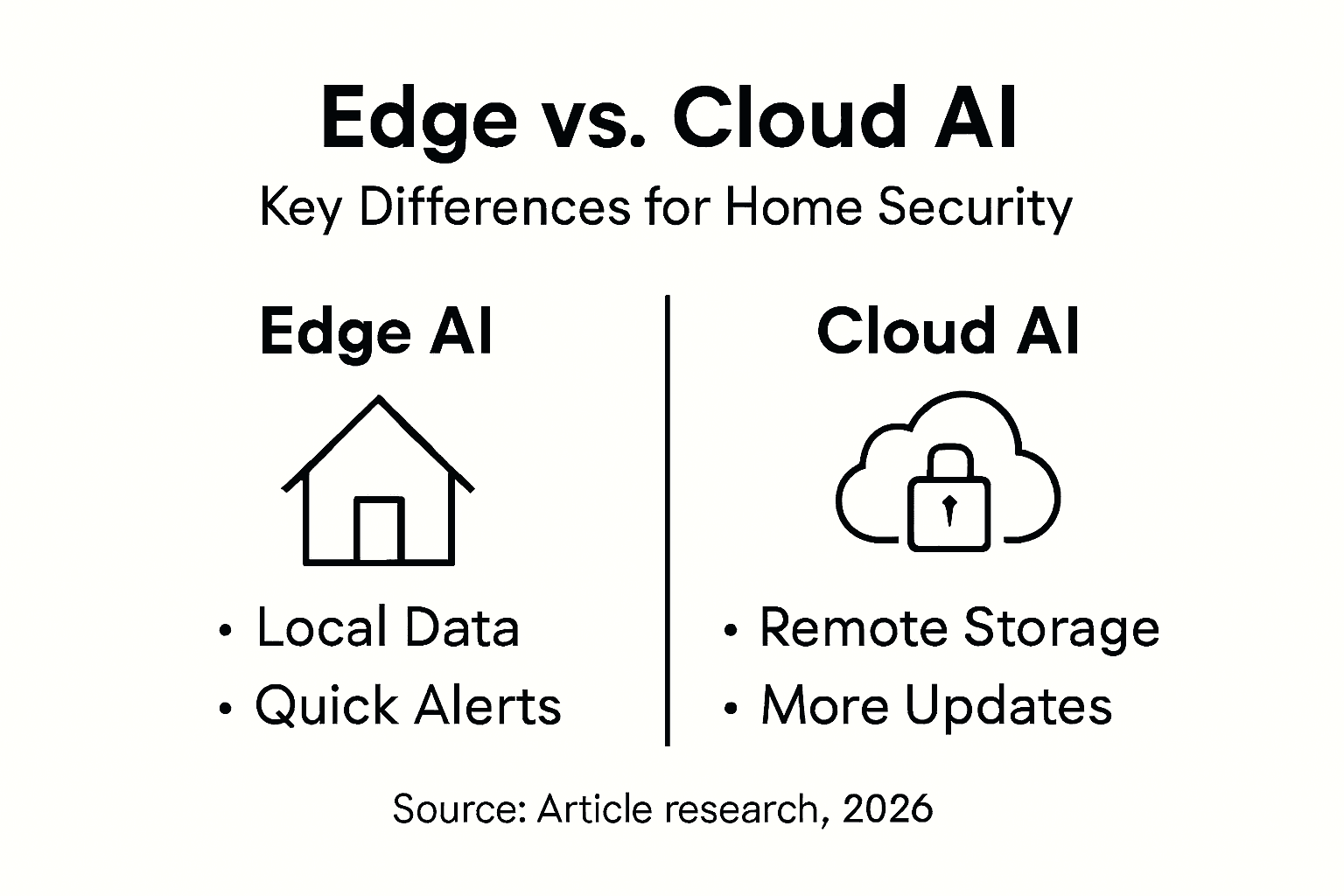
Here’s how Edge AI and Cloud AI differ for home security:
| Attribute | Edge AI (Local Processing) | Cloud AI (Remote Processing) |
|---|---|---|
| Privacy | Data never leaves your home | Data stored on external servers |
| Speed | Instant threat alerts | Noticeable delay due to upload |
| Internet Dependency | Works offline without internet | Fails or degrades offline |
| Data Control | Owner manages all footage | Company controls your data |
Pro tip: Verify that any AI home security system you choose can function offline and performs all critical threat detection locally, ensuring you maintain protection even when your internet connection fails.
Key Features of AI-Powered Security Devices
Modern AI security devices work because they’re built on capabilities that go far beyond simple motion detection. A quality AI security system combines multiple technological approaches working together. Machine learning algorithms and deep learning allow your devices to recognize patterns in video and sensor data that would be impossible for humans to catch manually. Your camera doesn’t just see movement; it understands what kind of movement matters. It distinguishes between your delivery person walking up the driveway and someone circling your property looking for an unlocked window. It knows the difference between leaves blowing across your yard and an actual person. This pattern recognition gets smarter over time as the system learns your home’s specific environment, seasonal changes, and daily rhythms.
Real-time threat detection stands as the most critical feature for home security. Your system processes what’s happening right now, not hours later when you review footage. Real-time monitoring and adaptive threat recognition mean you get alerts instantly when something suspicious occurs. Someone tampering with a door lock gets flagged before they gain entry. A person loitering outside your home triggers an alert before they can act. This speed matters because it’s the difference between prevention and damage control. You can call authorities while the threat is still present. You can verify what’s happening through your device before deciding whether to open your door or go outside. Traditional security systems record everything and hope you notice something wrong later. AI security devices prevent problems in real-time.
Anomaly detection represents another essential capability. Your AI security device learns what normal looks like for your specific home. What’s normal for a busy urban apartment differs completely from a quiet suburban house. Once the system understands your baseline, it spots deviations immediately. An unfamiliar car parking in front of your house. A person approaching from an unusual angle. Repeated attempts at the same door or window. Package theft happening in real-time instead of after the fact. The system catches these patterns faster than any human could because it’s watching 24/7 without fatigue or distraction. This adaptive approach means false alarms drop dramatically. You stop getting alerts for every shadow and start getting alerts for actual threats.
Integration with your smart home ecosystem amplifies these capabilities. Quality AI security devices don’t operate in isolation. They talk to your lighting system, your door locks, your other sensors, and your internet connection. When a threat is detected, your system can automatically activate exterior lights, unlock doors for escape routes, or secure entrances. When you’re away, the system can simulate occupancy by adjusting lights and sounds. When you’re home, it can give you granular control over what triggers alerts. This interconnected approach creates a comprehensive security layer rather than a single point of contact. You get alerts on your phone, your smartwatch, and your home hub. You can speak commands to lock doors or review camera feeds.
Personalized threat response settings distinguish truly intelligent systems from generic ones. Your home security needs differ from your neighbor’s needs. You might have delivery people coming at specific times, contractors working on your property, or friends visiting. A capable system learns your patterns and adjusts accordingly. It knows when to alert you aggressively and when to filter out normal activity. Intruder detection systems that offer personalized alert settings respect your lifestyle while maintaining protection. You define what constitutes a threat based on your own circumstances, not what some generic algorithm decides. This personalization is what separates security systems that actually work for you versus systems that constantly annoy you with false alarms.
Pro tip: Look for AI security devices that let you customize threat detection sensitivity for different times of day and days of the week, allowing you to maintain protection while reducing false alarms during your normal routines.
Real-World Applications and User Scenarios
AI home security stops being abstract when you see how it actually works in people’s lives. Consider Sarah, a single mother in Chicago who works late shifts at a hospital. She leaves her teenage daughter home alone most evenings. Traditional motion sensors would trigger constantly from her daughter moving around the house, creating useless alerts on Sarah’s phone all night. An AI security system learns the difference between normal household movement and actual threats. When Sarah’s daughter is home, the system recognizes her patterns. When someone approaches the house from outside, the system immediately alerts Sarah with video context. She can see exactly what’s happening before calling police. When her daughter forgets to lock the back door, the system detects the open entry point and notifies Sarah specifically about this vulnerability, not just generic motion.

Then there’s Marcus, who lives in a downtown apartment building in Boston. His biggest concern isn’t violent crime; it’s package theft. Delivery people come daily, and packages disappear from his hallway constantly. His doorbell camera used to record everything, but he never had time to review hours of footage to see which packages were stolen. AI-based behavioral analytics detect unusual activity patterns that humans would miss. Now his system recognizes his regular delivery people and delivery patterns. When someone lingers near packages or opens bags that aren’t theirs, the system alerts Marcus immediately. He’s caught three package thieves because the AI flagged suspicious behavior in real-time, not days later. He’s also reduced his false alerts from dozens per day to maybe two or three because the system understands what normal looks like for his building.
Consider the Garcia family in Phoenix, dealing with a different threat. They live in a neighborhood with increasing burglary attempts. Their concern isn’t about individual incidents; it’s about patterns. One burglar might scout homes for days before breaking in. Another crew might target the same area repeatedly. AI technologies detect suspicious patterns through behavioral analytics that would take human security teams weeks to identify. Their AI system recognizes when the same unfamiliar vehicle passes by multiple times within hours. It alerts when someone approaches the house multiple times on different days, learning and adapting to potential threats. The Garcias shared their alerts with neighbors, and together they spotted a pattern that led to a neighborhood watch preventing several break-ins. Their AI system became the neighborhood’s early warning system.
These scenarios reveal why AI matters differently than traditional security. Traditional systems are reactive. You review footage after something happens. AI systems are predictive. They flag concerning patterns before incidents occur. Sarah’s system doesn’t just record an intruder breaking in; it alerts her when someone’s jimmying her locks. Marcus’s system doesn’t record package theft; it flags suspicious behavior as it’s happening. The Garcia family’s system doesn’t document break-ins; it identifies patterns suggesting future risk.
The common thread across these real-world scenarios is that AI does the watching so you don’t have to. You get alerts that matter, informed by context and pattern recognition. You’re not drowning in false alerts from every motion or sound. You’re not spending hours reviewing footage hoping to spot something important. You’re getting proactive intelligence about actual threats to your home and family. This is why 2026 represents a turning point for home security. AI isn’t just an upgrade to cameras and sensors. It’s a fundamentally different approach to protecting what matters to you.
Pro tip: Start by setting up your AI security system with basic threat parameters, then let it learn your home’s normal patterns for at least two weeks before adjusting sensitivity levels, allowing the AI to develop accurate baselines for your specific environment.
Risks, Costs, and Common Missteps
AI home security isn’t risk-free, and understanding the pitfalls matters as much as understanding the benefits. The most significant risk centers on data security itself. Your AI security system collects sensitive information about your home. Video feeds show what your rooms look like, what you own, your daily schedules, and your family members. Audio recordings capture conversations and activities. Data re-identification and privacy leakage represent real threats. Even anonymized video data can sometimes be traced back to your specific home through metadata or distinctive features. If a company stores this data poorly or gets breached, this information becomes valuable to criminals who now know your home layout, your schedule, and your family’s vulnerabilities. The mistake most homeowners make is assuming the company handling their security data takes privacy seriously. Many don’t. They store footage indefinitely. They sell anonymized data to third parties. They share information with law enforcement without warrants. You need to verify exactly what happens to your data, not just assume it’s protected.
Cost represents another critical consideration. Quality AI security systems require investment upfront. Cameras with local processing capability cost more than basic motion-sensor cameras. Edge AI devices that run intelligence locally cost significantly more than cloud-dependent alternatives. Then there are ongoing costs. Subscription services for video storage, advanced features, or professional monitoring add up. Cloud-based AI services charge per camera or per month. Annual costs can easily reach hundreds of dollars for a properly equipped home. Many homeowners start with budget options, then discover the limitations and end up replacing equipment. This false economy wastes money. The initial cheap system doesn’t meet your actual needs, forcing expensive upgrades. Budget appropriately from the start rather than replacing systems repeatedly.
A critical misstep involves inadequate security in the AI system itself. Secure development and continuous monitoring prevent vulnerabilities that hackers can exploit. Some manufacturers deploy AI security systems without proper security architecture. Their algorithms have known vulnerabilities. Their devices lack encryption. Their software updates are infrequent. This creates a situation where your security system becomes a liability rather than protection. An attacker can disable the system, manipulate alerts, or access your cameras remotely. You think you’re protected when you’re actually exposed. This happens when you choose systems based solely on price or brand recognition without verifying their actual security practices.
Another common mistake involves underestimating what can go wrong. AI systems can be tricked. Adversarial attacks exploit AI vulnerabilities by feeding the system data it’s not trained to handle. Someone could wear specific clothing patterns to confuse facial recognition. Sophisticated attacks could manipulate your camera feeds without obvious detection. Voice synthesis technology could potentially create fake audio of someone you know requesting door access. These might sound like science fiction, but they’re real vectors that bad actors are actively researching. Your system needs to account for these threats through redundancy and verification.
False alarms represent an underestimated cost that wears on you psychologically. A system that triggers alarms constantly degrades your trust in the system. You start ignoring alerts. You disable notifications. Your system becomes background noise rather than security. This happens when manufacturers don’t properly calibrate their AI or when homeowners fail to customize settings for their specific environment. You get flooded with alerts about nothing, making you tune out the system when real threats occur. The solution requires patience during setup. Let the system learn. Customize sensitivity settings. Test different configurations. Don’t expect it to work perfectly immediately.
Family dynamics introduce another overlooked risk. Your AI security system needs to respect household members while protecting against outsiders. Children might feel surveilled if cameras monitor their bedrooms. Partners might resent loss of privacy. You need to establish clear boundaries about where cameras operate and who can access footage. This isn’t just about comfort; it’s about legal liability. Recording in certain areas might violate local privacy laws. Sharing access with contractors or service providers creates security vulnerabilities if not managed carefully.
Consider these common risks and their potential impacts when using AI security systems:
| Risk Factor | Example Impact | How to Mitigate |
|---|---|---|
| Data Breach | Home activity exposed | Choose systems with local storage |
| False Alarms | Missed real threats | Calibrate sensitivity carefully |
| Vendor Lock-in | Lose data if provider fails | Select systems with offline access |
| Algorithm Manipulation | Bypassed security alerts | Ensure regular software updates |
Pro tip: Before purchasing any AI security system, verify that it can operate entirely offline with all critical threat detection happening on the device itself, ensuring you maintain protection even if the company goes out of business or changes its privacy policies.
Alternatives and the Future of Home Security
When you’re evaluating home security options in 2026, you’re not just choosing between different AI systems. You’re choosing between fundamentally different approaches to protecting your home. Traditional security companies like ADT have dominated for decades by offering professional monitoring, rapid response dispatch, and established infrastructure. They employ human operators who review alerts and call police on your behalf. This approach works, but it comes with costs. You’re paying for a service that treats your security as one of thousands they manage. Your data flows through corporate servers. Your decisions depend on their availability and their policies. The alternative is taking control into your own hands with edge AI systems that process everything locally and give you direct power over your security decisions.
The future isn’t about choosing one approach exclusively. Hybrid solutions are emerging that combine professional monitoring with AI-powered automation. You get AI threat detection running locally on your devices, providing instant alerts and automated responses. You also maintain the option for professional monitoring when you need human verification or rapid police dispatch. This middle ground appeals to many homeowners who want both intelligence and backup. However, it introduces complexity. You’re managing multiple systems from different companies. You’re paying subscription fees on top of hardware costs. You’re trusting your data to multiple organizations instead of keeping it entirely private.
Affordability represents a critical factor shaping the future. Emerging security solutions prioritize affordability and ease of installation while maintaining advanced capabilities. Budget-conscious homeowners can no longer choose between sophisticated AI and low costs. Manufacturers are developing edge AI devices that cost less than professional monitoring subscriptions yet deliver superior threat detection. These systems eliminate the monthly service fees that accumulate to thousands of dollars over years. You own your equipment and maintain your privacy without ongoing subscription commitments. The trade-off is that you’re responsible for managing the system yourself. You review alerts. You decide when to call police. You handle customer support directly with the manufacturer.
Interoperability matters increasingly. Future security systems won’t operate in isolation. Privacy-preserving technologies integrated with smart home ecosystems will enable your security system to communicate with your lighting, locks, thermostats, and other connected devices without exposing sensitive data to cloud servers. Imagine your security system detecting someone at your back door and automatically unlocking it for you to escape, adjusting lights to disorient potential intruders, and alerting neighbors simultaneously. All of this happens locally, without sending data to the internet. Your smart home becomes genuinely intelligent about security rather than just being a collection of connected gadgets.
The biggest shift in home security through 2026 centers on control. Traditional security companies control your experience. They decide which features you can access, how much to charge, what happens to your data, and when they might go out of business. AI-powered edge systems shift control back to you. You decide what gets recorded and what gets deleted. You control who sees your footage. You decide when to upgrade. You maintain your security even if the company disappears. This fundamental difference drives the future of home security. Homeowners are increasingly unwilling to trade privacy and control for convenience. They want security systems that work for them, not systems where they work for the company.
The question isn’t whether AI will replace traditional security companies. It’s whether homeowners will choose AI-powered alternatives once they understand what’s possible. Some will prefer professional monitoring and accept the trade-offs. Many will choose local AI processing and retain complete control. The smartest approach involves understanding your actual needs. If you want someone else managing your security, professional monitoring works. If you want intelligence, privacy, and control, edge AI is your answer. The future of home security isn’t one size fits all. It’s about having real choices based on what matters to you.
Pro tip: Evaluate security alternatives by asking a simple question: If the company goes out of business tomorrow, will my home still be protected and will I retain access to my security data? If the answer is no, the system prioritizes the company’s interests over yours.
Take Control of Your Home Security with True Edge AI
The article highlights the critical need for home security systems that prioritize privacy, local intelligence, and continuous adaptation. Many homeowners face challenges with false alarms, data breaches, and losing control over their personal security data when relying on cloud-based AI solutions. You want a system that protects your family with real-time threat detection without sacrificing your privacy or leaving you vulnerable to internet outages or company policies.
At IRVINEi, our breakthrough device OVAL embodies these core principles by running powerful AI entirely on your own device. Acting as your personal assistant and home bodyguard, OVAL combines security, automation, and companionship in one elegant solution that respects your privacy and puts you in full control. Learn how OVAL turns the vision of intelligent living into reality by visiting our Home page – IRVINEi.

Secure your home like never before with OVAL’s edge AI technology. Experience immediate threat alerts, complete data privacy, and seamless smart home integration. Don’t wait for an incident to realize the importance of privacy-first AI security. Visit https://hellooval.com today to discover how you can bring the future of intelligent living to your home and regain control of your safety.
Frequently Asked Questions
What is the primary benefit of AI in home security compared to traditional systems?
AI in home security offers predictive capabilities that allow systems to identify and react to real threats in real-time, rather than just recording footage or triggering alarms like traditional systems. This reduces false alarms and enhances overall security.
How does edge AI differ from cloud AI in terms of privacy and security?
Edge AI processes data locally on your device, keeping your footage and personal information within your home, which enhances privacy. In contrast, cloud AI transmits data to remote servers, increasing exposure to potential breaches and privacy concerns.
What should I consider when selecting an AI security system for my home?
When choosing an AI security system, consider how it protects your privacy, whether it prevents manipulation of its data, and what happens during software updates. Systems that operate locally with edge AI are often more secure.
How can I ensure my AI security system remains effective over time?
To keep your AI security system effective, allow it to learn your home’s normal patterns for at least two weeks, calibrate the sensitivity settings based on real feedback, and stay updated on the manufacturer’s practices regarding system maintenance and software updates.
